Blog › Sleep › Shift workers and doctors
Sleep for Shift Workers, Doctors and Nurses: How to Sleep Well on Any Rota
By Satyavadan Prakhya · November 3, 2026 · 8 min read
Doctors, nurses, police, pilots, factory and call-centre staff, security guards, delivery drivers – millions of people work while the rest of the world sleeps. Night and rotating shifts fight against the body clock, so shift workers need a smarter plan, not just willpower. This guide is written especially with doctors and nurses in mind, but it works for any shift job.
The benchmark for shift workers
You still need 7–9 hours in every 24 – but it doesn't have to be in one block. A main sleep of 5–6 hours plus a planned nap can work. The goals: enough total sleep, a regular pattern for each type of shift, and staying alert (and safe) on duty and on the drive home.
Sleep plans by shift type
| Shift | Main sleep | Extra tips |
|---|---|---|
| Early morning (starts 5–7 AM) | Go to bed early, around 9–10 PM | Dim lights and no screens in the evening; prepare uniform and food the night before |
| Evening (ends 11 PM–midnight) | Sleep about 1 AM to 9 AM | Wind down with a fixed routine after work; blackout curtains |
| Night shift | Sleep straight after getting home in the morning | Nap 20–90 minutes before the first night shift; light breakfast, then sleep |
| 24-hour / on-call (doctors) | Take any safe chance to nap during the shift | Recovery sleep after, then return to a normal schedule; avoid driving after a 24-hour shift |
| Rotating rotas | Shift sleep times gradually with the rota | Forward rotation (morning → evening → night) is easier on the body than backward |
During the night shift
- Bright light in the first half of the shift helps you stay alert.
- Caffeine early in the shift only – none in the last 4–6 hours, or you won't sleep after.
- A short planned nap (10–30 minutes) during a break, if your workplace allows it, improves alertness and safety.
- Light, healthy snacks instead of heavy meals at 3 AM; keep drinking water.
- For doctors: double-check doses and critical decisions between about 3 and 6 AM, when alertness is naturally lowest.
After the shift: sleeping in the daytime
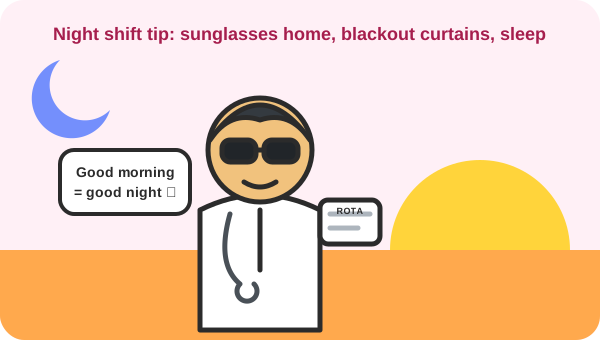
- Wear sunglasses on the way home – morning daylight tells your brain it's time to wake up.
- Make the bedroom a cave: blackout curtains or an eye mask, earplugs or a fan for white noise, and a cool temperature.
- Phone on silent and tell family and friends your sleeping hours. A “Sleeping – please don't knock” sign on the door helps.
- Keep the same pre-sleep routine as at night: shower, light snack, bed.
🚗 Drowsy driving is a serious risk after night and long shifts. If you're very sleepy, take a 15–20 minute nap before driving, use public transport or a taxi, or arrange a lift. Opening the window or turning up the music doesn't work.
Days off
- After a run of nights, take a short sleep (3–4 hours) in the morning, then stay up until a normal bedtime to reset.
- Protect family time and daylight exposure – they help your mood and body clock.
- Plan the week's sleep in advance, just like you plan the rota.
Long-term health for shift workers
Years of night work are linked with higher risks of weight gain, type 2 diabetes, heart disease, stomach problems and low mood. Regular health checks, exercise, a steady eating pattern and enough total sleep help reduce these risks. If you sleep poorly on most days off too, or feel exhausted all the time, ask your doctor about shift work disorder – there are treatments.
This article is general health education, not medical advice. Sleep problems can have many causes. If you're worried about your sleep or anyone in your family, please speak to a qualified doctor.
Helpful tools
- Blackout curtains – turn daytime into night for post-shift sleep.
- A contoured sleep mask – blocks light without pressing on your eyes.
- A white noise machine – masks daytime traffic and household noise.
As an Amazon Associate, Study Timer earns from qualifying purchases. This doesn't change the price you pay.
Studying for exams between shifts? Use short, focused sessions.
Open the free Study Timer →